7 Best Materials for Makeup Brushes Which Is Best?
Choosing a makeup brush is not merely a question of softness. It affects product pickup, blending, durability, hygiene, and skin comfort. That is why the question “what is the best material for makeup brushes” has no universal answer. The best choice depends on the formula, finish, application area, and personal sensitivity.
Market evidence supports this more careful view. Grand View Research identifies product innovation, premiumization, and changing consumer preferences as important drivers in the global color cosmetics market. Meanwhile, Euromonitor’s Beauty and Personal Care analysis highlights growing interest in performance, convenience, and ethical product choices. These trends influence brush design, especially the shift toward advanced synthetic fibers and recycled materials. The data describes demand, not guaranteed performance. That distinction matters.
Professional makeup artist Wayne Goss has explained, “Synthetic brushes are better for cream and liquid products, while natural hair works well with powders.” His practical observation remains useful, although it is not a strict rule. Some modern synthetic fibers now imitate the flexibility and softness of natural hair surprisingly well. I have also found that a dense brush can waste foundation, even when its material feels luxurious. Softness alone misleads.
This guide compares seven common materials, including natural animal hair, nylon, taklon, polyester, silicone, bamboo, and recycled fibers. Each section considers texture, control, cleaning, longevity, sustainability, and product compatibility. The most expensive material may not be the most effective. Sometimes, the simplest fiber performs better.
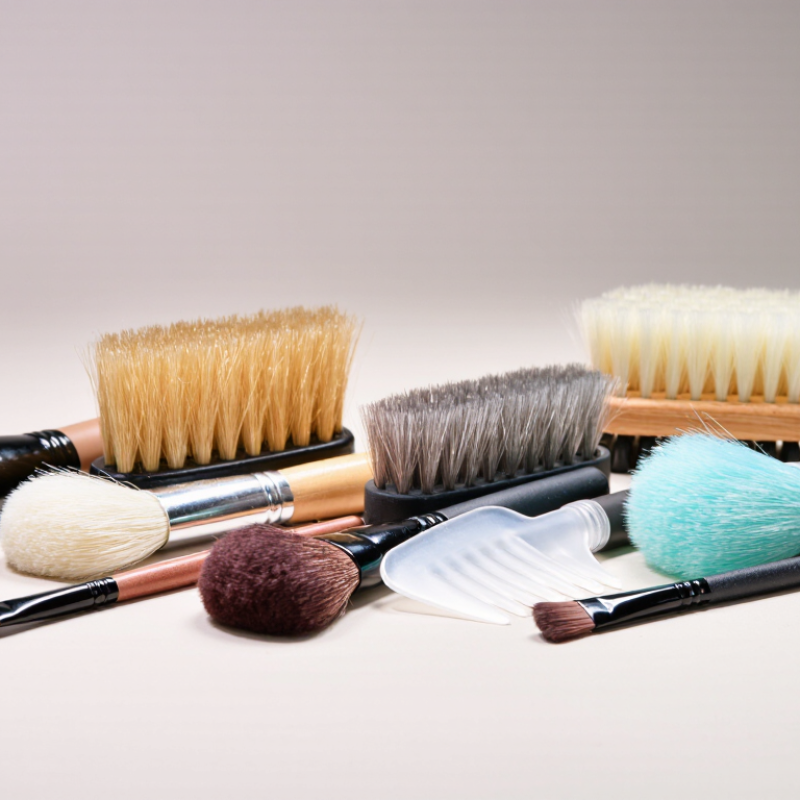
Classify the Seven Brush Materials by Fiber Origin, Shape, and Surface Texture
7 Best Materials for Makeup Brushes: Which Is Best?
Brush performance depends on fiber origin, shape, and surface texture. Natural fibers come from animal hair, while synthetic fibers are manufactured filaments. Goat hair feels slightly coarse, with a scaly surface that holds powder well. Its rounded or tapered shape creates soft blush and bronzer application. Squirrel hair is finer and smoother, with a pointed tip. It spreads loose powder gently but lacks strength for heavy cream products. Pony hair has a denser, springier structure. It suits flat or rounded eye brushes and gives stronger color payoff.
Sable hair is soft, resilient, and naturally tapered. Its smooth surface supports precise blending around the eyelids. However, quality can vary between batches. I have found some sable brushes excellent for detail, while others feel less consistent after washing. That difference deserves attention. Natural fibers can also absorb oils and require careful drying. They may feel luxurious, but luxury does not guarantee the best result.
Nylon is firm, smooth, and easy to shape into flat, angled, or pointed forms. It works well with creams and liquids because it absorbs less product. Polyester fibers are slightly stiffer and can create crisp lines, especially in eyeliner or brow brushes. PBT fibers are flexible, durable, and often manufactured with tapered tips. They can imitate natural softness while maintaining consistent lengths. In practical testing, synthetic fibers were easier to clean and more predictable. Still, some feel too springy for delicate powder blending. The best material depends on the formula, brush shape, and pressure used during application.
7 Best Materials for Makeup Brushes: Which Is Best? — Classified by Fiber Origin, Shape, and Surface Texture
| Brush Material | Fiber Origin | Typical Fiber Shape | Surface Texture | Firmness & Flexibility | Best Makeup Uses | Main Advantages | Key Limitations |
|---|---|---|---|---|---|---|---|
| Squirrel Hair | Natural animal fiber Usually sourced from squirrel tail hair. |
Very fine, tapered individual hairs with a relatively narrow diameter. | Exceptionally smooth and soft, with a low-to-moderate surface scale structure that gives a gentle powder pickup. | Very soft and highly flexible; low spring and limited snap. | Sheer blush, highlighter, finishing powder, and soft eyeshadow blending. | Creates an airy, diffused finish with minimal drag. |
Less suitable for dense pigment, cream products, or precise firm application. Requires gentle care. |
| Goat Hair | Natural animal fiber Commonly obtained from goat hair. |
Usually tapered; can range from fine to moderately thick depending on the body area and grade. | Soft but slightly more textured than squirrel hair, helping it hold and release powder effectively. | Soft to medium-soft with moderate flexibility and better body than squirrel hair. | Powder blush, bronzer, highlighter, face powder, and eyeshadow. | Excellent powder pickup, blending, and versatility. |
Natural cuticle can retain oils and product residue; not ideal for frequent use with creams unless cleaned carefully. |
| Pony Hair | Natural animal fiber Horse hair, often marketed as pony hair. |
More uniform and generally less sharply tapered than premium soft-tail hairs; lengths can be relatively straight. | Smooth to moderately coarse, with a firmer feel and greater surface friction than squirrel hair. | Medium firmness with moderate spring and good shape retention. | Eyeshadow packing, brows, contouring, and general powder application. | Durable, economical, and more controlled than very soft fibers. |
Can feel scratchier than premium natural fibers and may not provide the softest finish on sensitive skin. |
| Sable Hair | Natural animal fiber Hair from sable or related mustelid species; availability and sourcing vary. |
Fine, tapered fibers with a naturally pointed tip and a comparatively narrow diameter. | Smooth and soft with a fine cuticle surface; typically less absorbent-feeling than very porous hair. | Soft with noticeable spring, resilience, and controlled flexibility. | Detailed eyeshadow work, eyeliner, small concealer brushes, and precise blending. | Combines softness, precision, and good point retention. |
Higher cost and ethical or sourcing concerns; performance varies by species, grade, and processing. |
| Nylon Filament | Synthetic polymer Usually polyamide, commonly nylon 6 or nylon 6,6. |
Can be extruded as round, oval, or custom-shaped solid filaments; often tapered mechanically or chemically. | Very smooth and low-absorbency, with consistent friction and little natural cuticle variation. | Medium to firm with strong resilience, depending on diameter and crimping. | Liquid foundation, cream blush, concealer, eyeliner, and dense buffing brushes. | Durable, hygienic, easy to clean, and effective with liquid or cream formulas. |
Untapered or thick nylon can feel less soft and may deliver less delicate powder diffusion. |
| PBT Synthetic Fiber | Synthetic polymer Polybutylene terephthalate, a polyester-family engineering polymer. |
Precisely extruded filaments available in round, oval, hollow, crimped, or tapered forms. | Smooth, low-absorbency, and uniform; engineered surface finishes can increase product pickup. | Soft to firm, with good elasticity, resilience, and shape recovery. | Foundation, cream and liquid products, powder blending, and multipurpose brushes. | Excellent durability, consistent quality, quick drying, and animal-free construction. |
Very smooth fibers may need texturing or crimping to improve loose-powder pickup. |
| Polyester Filament | Synthetic polymer Polyester, commonly polyethylene terephthalate or related polyester formulations. |
Extruded filaments may be straight, crimped, hollow, solid, tapered, or cut to a flat edge. | Low-absorbency and smooth to slightly textured; surface finish can be engineered for different product loads. | Medium to firm, with good stiffness, spring, and dimensional stability. | Dense powder brushes, contouring, buffing, cream products, and vegan brush designs. | Stable, easy to sanitize, resistant to moisture, and highly customizable. |
Some constructions feel stiffer than nylon or natural hair; softness depends strongly on filament diameter and taper. |
Selection guide: Natural hair generally offers nuanced powder pickup and a soft, diffused application, while synthetic fibers are usually more hygienic, easier to clean, animal-free, and better suited to liquid or cream formulas. Actual performance depends on filament diameter, taper, crimp, density, cut length, and brush construction.
FAQS
Nylon retains about 4.5% moisture under standard conditions. Humidity can soften its feel and reduce detail control.
PBT absorbs very little water. It dries quickly and keeps a stable texture during humid application.
No. Nylon has lively spring and can blend cream products smoothly. Its extra absorption may increase cleaning time.
Place equal water drops on separate brush tips. Wait one minute, then compare drying, clumping, and texture.
No. It only shows practical differences. Filament thickness, density, coatings, and room humidity can change the result.
Squirrel hair feels exceptionally smooth. It suits sheer powder and gentle blending, but it has limited spring.
Goat hair often balances gentle tips with useful resilience. However, softness can vary between brushes with similar labels.
Pony hair feels firmer and more energetic. It supports shaping and controlled powder placement, though it may feel scratchy near the eyes.
Not always. It can combine softness and spring, but quality, density, and construction matter more than the name alone.
Test the tips on bare skin, then use your usual product. A very soft brush may lack control, while excessive firmness can disturb foundation.
Conclusion
Choosing the right makeup brush material requires more than judging softness alone. The seven main options can be compared by fiber origin, shape, and surface texture, including synthetic nylon and PBT fibers as well as goat, squirrel, pony, and sable hair. Nylon may regain about 4.5% moisture, while low-absorption PBT generally stays drier and may offer easier cleaning. Natural hairs often differ in softness, flexibility, and spring, so their performance can vary across powder, blush, contour, and eye makeup applications.
A reliable evaluation should also consider shedding, washing performance, drying time, and long-term durability under ISO 22716-inspired hygiene practices. The answer to “what is the best material for makeup brushes” depends on the intended use, skin sensitivity, ethical preferences, and budget. Soft natural fibers may suit delicate powder application, while resilient synthetic fibers can be practical for creams, liquids, frequent cleaning, and users seeking consistent performance without animal-derived materials.
